

Part 04
What Is RAG, and What Does It Mean to Make It Agentic?
In the previous part, we looked at how tools help AI agents interact with real-world systems — send emails, file tickets, trigger APIs.
But what if the model doesn’t need to act?
What if it just needs access to the right information?
That’s the case in many enterprise settings:
Internal docs spread across teams
Policy PDFs no one remembers writing
Customer insights buried in CRM notes
Dashboards and emails with useful context
Tools won’t help here. The model needs to think with your data.
That’s where RAG comes in.
What Is RAG?
RAG stands for Retrieval-Augmented Generation.
It’s a system design where the model retrieves relevant information from your own data — just before generating a response.
Instead of relying only on what the model was trained on, RAG gives it access to live, contextual information from your enterprise systems. This makes answers more accurate, grounded, and auditable.
You might be wondering:
“Why not just give all the data to the model directly?”
The problem is:
Models can only process a limited amount of text at a time.
Even within that limit, they struggle when too much irrelevant or noisy information is included.
This makes responses less focused and more error-prone.
The RAG Process (at a Glance)
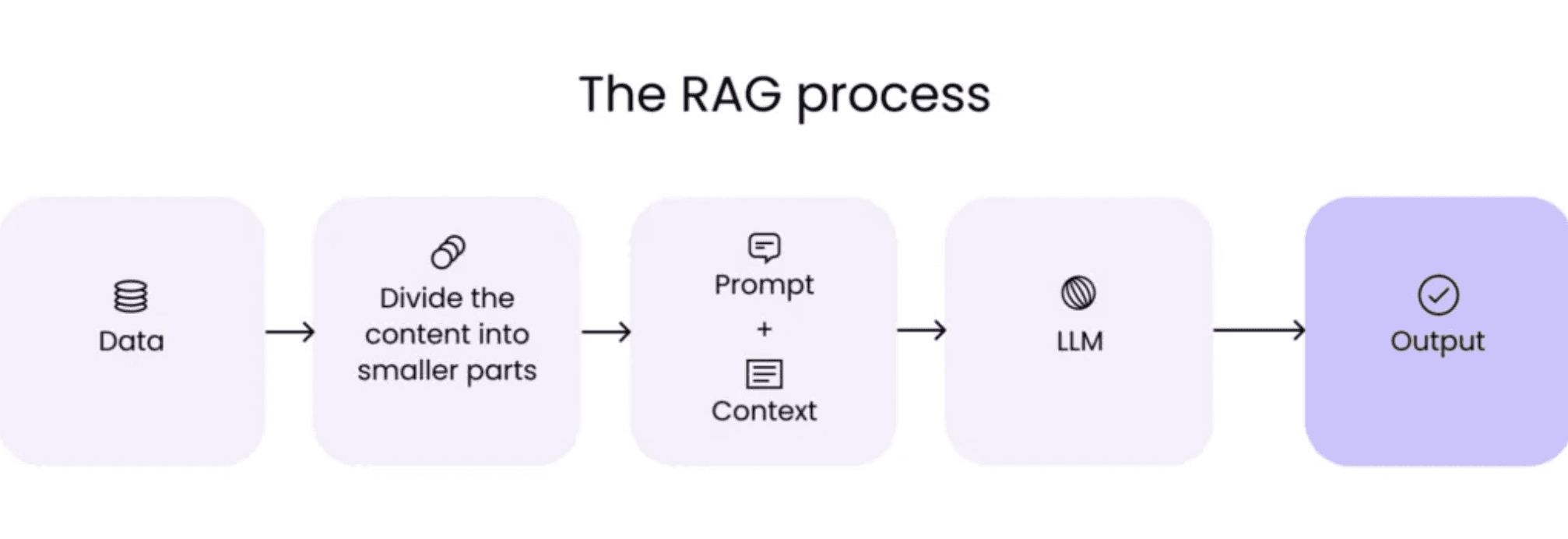
Here’s what it looks like in practice:
Data – Your internal content (PDFs, emails, notes, wikis)
Chunking – Broken into smaller parts for better indexing
Prompt + Context – At query time, the system retrieves relevant pieces (retrieval phase)
LLM – The model uses that context to generate a response
Output – The result is based on your data, not just what the model “knows”
Image Source: https://hyperight.com/7-practical-applications-of-rag-models-and-their-impact-on-society/
Why RAG Is Everywhere in Enterprise AI
You’ll often hear this number:
From what I’ve seen across clients and systems, 70% of enterprise GenAI use-cases use RAG.
Why RAG is invaluable to enterprises:
Enterprise knowledge changes frequently
Fine-tuning models is expensive and slow
Retrieval is faster, safer, and easier to control
It brings structure and traceability into LLM systems
It works on both unstructured (docs) and semi-structured (dashboards, notes) data
So instead of asking:
“How do I teach the model everything we know?”
Most teams ask:
“How do I let the model fetch what we already have?”
RAG = LLM + Additional Retrieved Data
RAG became the dominant pattern in 2024 for a reason:
It bridged the gap between general-purpose LLMs and private, task-specific enterprise knowledge.
At its core, RAG is simple:
You take an LLM
You feed it additional, retrieved information right before generation
This makes the model more accurate, more context-aware, and less reliant on memorized facts.
It’s especially useful for tasks like Q&A, summarization, and policy lookups — particularly in data-rich environments like legal, finance, and support.
No wonder 2024 was dubbed “the year of RAG.”
But Now We’re Moving Into the Agentic Era
RAG isn’t going away, but it’s evolving.
Today’s systems don’t just retrieve once and generate an answer.
In agentic workflows, retrieval becomes part of a broader, dynamic reasoning loop.
Agents plan, retrieve, reflect, and retrieve again — not just once, but as many times as needed throughout a task.
That’s where Agentic RAG comes in.
What Is Agentic RAG?
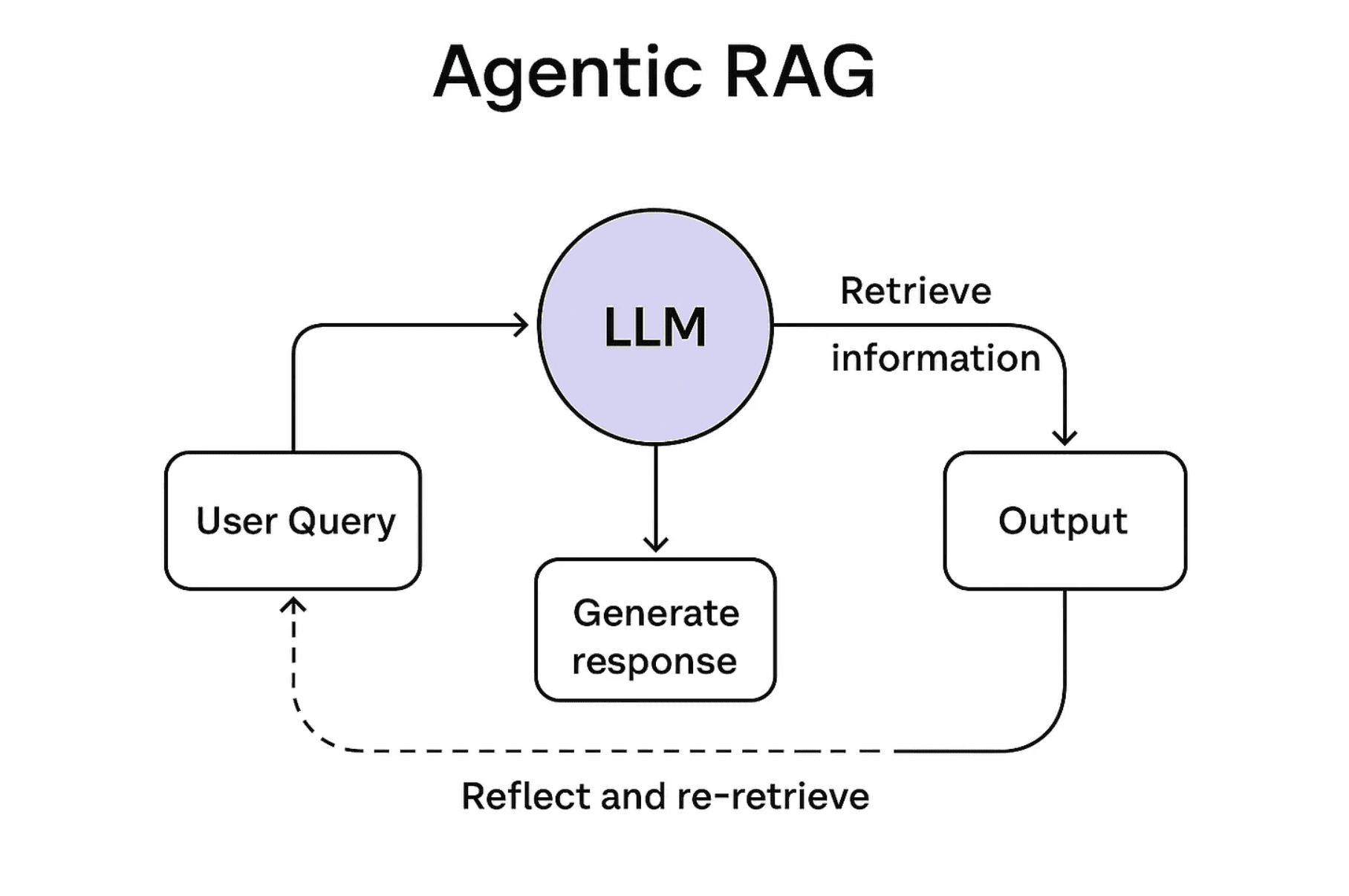
Traditional RAG:
One query
One retrieval
One response
It works well for standalone questions like:
“What’s our policy on PTO rollover?”
But most real-world enterprise workflows aren’t one-shot.
Example:
Let’s say you’re building a deal assistant for your sales team.
In a single task, the agent may need to:
Pull the customer’s CRM history
Retrieve current pricing for their segment
Look up regional legal terms
Reference past contract clauses
Generate a custom proposal
Double-check facts
Log the interaction
In agentic systems, retrieval isn’t just a setup step.
It’s how the agent:
Gathers missing context
Checks its assumptions
Adapts mid-task
That means RAG becomes:
A tool for in-task learning
A method for reducing hallucinations
A mechanism for handling dynamic workflows
A bridge between reasoning and grounded enterprise knowledge
Agentic RAG turns retrieval into a first-class decision-making loop by using retrieval as part of the model’s thinking process.
RAG as a Tool
If you think about it, RAG is also a kind of tool.
But instead of triggering an action, it helps the agent pull the right information from a large volume of data.
In practice, agents often combine:
RAG
Tools
Planning
…to complete complex tasks reliably and contextually.
A Note on Scope
RAG is a deep and rapidly evolving space — honestly, it could be its own course.
If you're curious to explore further:
I’ve curated a GitHub repo of key RAG papers that covers the landscape well
I have a 101 guide on Agentic RAG too
That said, not every RAG optimization is necessary for every use-case.
In our 6-week course, we focus on helping you understand when and where each technique makes sense, rather than applying them blindly.
In the next part, we’ll dive into one of the most talked-about concepts lately: Model Context Protocol (MCP).
To get the most out of it, we’d recommend revisiting Part 3 on tools, since MCP builds directly on that concept!