

Part 05
What Is MCP and Why Should You Care?
First, a Quick Recap
Part 3: We learned that tools let models do things.
Part 4: We saw that RAG helps models find relevant info before answering.
These are external supports — they help the model act smarter, but the coordination still sits outside the model.
But what if you could pass all the context a model needs — tools, retrieved data, memory, instructions — in one clean, structured format?
That’s what Model Context Protocol (MCP) is trying to solve.
So What Is MCP?
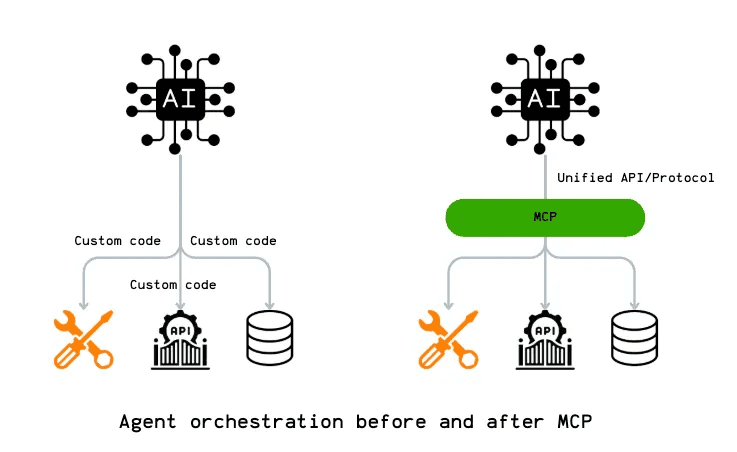
At its core, Model Context Protocol is a standardized way to give an LLM everything it needs to reason and respond.
Think of it like packaging up:
The task you want the model to do
The tools/APIs it can use
The documents or memory it might need
The prior messages in the conversation
…and then handing all of that over in one go.
It’s not a tool, library, or product.
It’s a protocol — a structure for communication between the model and the outside world.
If you’re from the tech world, equivalents would be: HTTP, TCP/IP, or SMTP.
If you’re not, just remember: tech folks love standardization — it makes things easier to reuse and plug together.
Why Does This Matter?
Let’s say you’re building an agent.
Right now, you’re probably juggling:
Sending a prompt
Passing retrieved documents
Registering tools
Managing state
Keeping track of what happened before
MCP says:
“Let’s standardize how we give all of that to the model, so we don’t reinvent the wheel for every use case.”
And for enterprises, this matters a lot.
As agents get more complex, coordinating tools, RAG, memory, and outputs becomes messy.
MCP makes that orchestration composable, modular, and easier to plug into other systems.
If you’ve ever worked with APIs, think of MCP like a well-defined request schema.
Instead of tossing everything into one long string and hoping the model figures it out, the model still sees text — but it’s structured, with clear context, options, and grounding.
Why Did MCP Catch On So Fast?
Given that MCP is just a protocol, you might be wondering:
What makes it better, and why did everyone jump on board?
Here’s what helped:
AI-Native — MCP was built for AI agents. It makes space for everything agents use today: tools, prompts, memory, documents, and more.
Strong docs and examples — Anthropic (creators of MCP) released not just the spec but also clients, SDKs, testing tools, and real-world demos.
Network effect — Released quietly in Nov 2024, most people slept on it… until 2025, when it exploded. Tools, startups, and even OpenAI began supporting it.
Common Misunderstandings
MCP isn’t a new API or product — It’s just a pattern, a clean way to frame what you send to the model.
It doesn’t make models smarter — It just gives them better, more structured context.
It’s not just for agents — Even simple assistants benefit from better context management.
So… Should You Care?
If you’re building toy prompts or quick demos — probably not (yet).
But if you’re working on:
Enterprise-grade agents
Multi-tool workflows
LLMs that need to access memory + RAG + planning
Systems where context management is a bottleneck
…then yes, you should care. MCP is about getting better at passing evolving, structured context into models.
But keep in mind: MCP is just a protocol.
Like all standards, it only works if it’s widely adopted.
If something better comes along before MCP becomes “the HTTP of agents,” the ecosystem might shift again.
Further Reading & Resources
We did a full deep-dive article on MCP, including clients, servers, and real-world use cases (written by Kiriti Badam, OpenAI).
We also ran a free live session — you can catch the recording here.
In the next part, we’ll learn about the planning component of agentic systems and why it matters.
PS: We also teach a widely loved course on how to actually build AI systems in this fast-changing environment, using a problem-first approach. It’s designed for PMs, leaders, engineers, decision-makers etc. who are working within real-world constraints. Alumni come from Google, Meta, Apple, Netflix, AWS, Spotify, Snapchat, Deloitte, and more. Our next cohort starts soon. Our next cohort starts soon. Early bird pricing is live: use the code "GITHUB" to get $300 off (Valid only for August 2025) to register here!!