

Part 08
Multi-Agent Systems
So far, we’ve talked a lot about what makes a single agent act — from tools and RAG to memory and planning.
But what if your agentic pipeline needs to:
Parallelize tasks to speed things up
Use different agent personas for different parts of a task
Break up complexity across specialized units, like in a team
That’s where multi-agent systems come in.
Why Use Multi-Agent Systems?
Sometimes, a single agent just can’t cut it because the problem demands scale, specialization, or parallel thinking.
Examples:
Generating a marketing strategy that needs market insights, legal review, and creative suggestions.
Building a compliance assistant that needs to extract information, flag risks, and cross-check policies.
Automating a sales process where one agent talks to the user, another enriches data, and a third handles follow-ups.
Could you do this with one beefy agent?
Maybe.
But splitting it into multiple, specialized agents can enable:
Parallelization → Agents work on parts of a task simultaneously
Specialization → One agent is great at legalese, another at writing emails
Tooling independence → Each agent can have its own tools and memory
Flat vs Hierarchical Agent Coordination
All multi-agent systems need some way to coordinate.
Two common communication patterns:
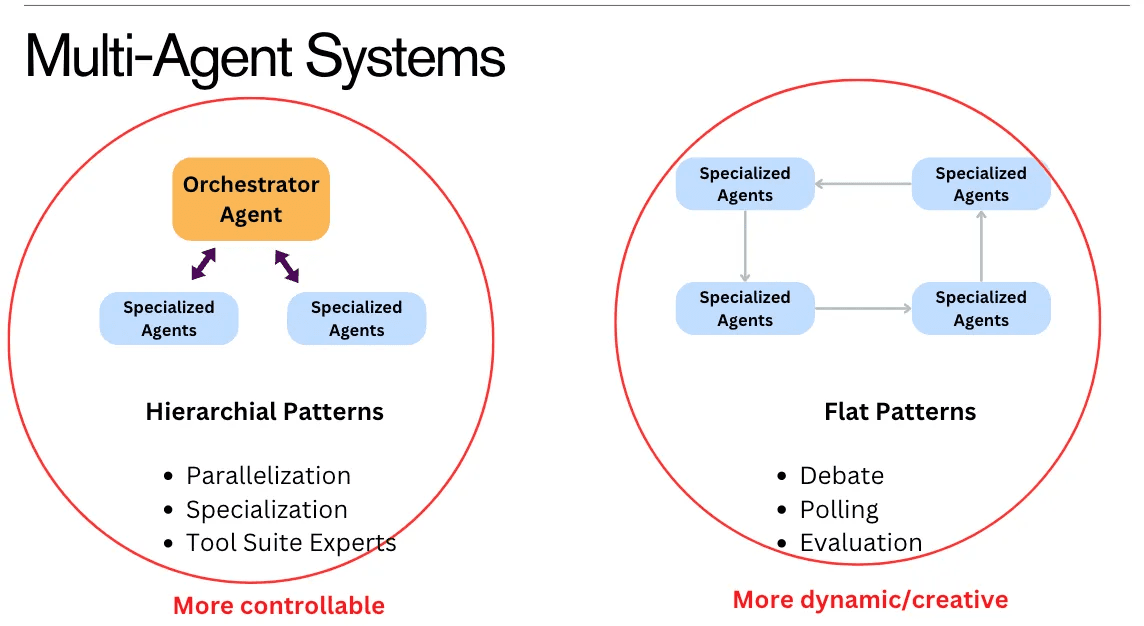
1. Hierarchical Patterns (More Controllable)
An orchestrator agent delegates subtasks to others.
It sees the full picture and controls the flow.
Use when:
Tasks can be clearly decomposed
You want tight control
You have known agent roles (e.g., summarizer, generator, checker)
Think: enterprise workflows, tool suites, parallel pipelines.
2. Flat Patterns (More Dynamic)
Agents talk to each other as peers — no boss.
Use when:
Tasks need creativity or debate
You want agents to evaluate each other
There’s no one “correct” answer path
Think: brainstorming, ranking options, multi-view reasoning.
What Nobody Tells You: Multi-Agent Systems Are a Pain
On paper, this sounds great.
And sure, you can build quick multi-agent prototypes and have fun with them.
But for customer/enterprise use cases… it’s painful.
Most people read a blog on multi-agent systems and get excited about modularity —
“It’s like microservices!” they say.
But AI agents are not microservices.
Unlike code, AI models are non-deterministic. They don’t always behave the same way.
Adding more agents means:
More non-determinism (variation across agents, not just within one)
More memory and state complexity (who knows what, and when?)
Higher latency and cost
More coordination bugs and failure points
More collusion, where agents agree when they shouldn’t (happens more than you think)
Honestly, I could write a book on how painful it is to get multi-agent systems working reliably.
So… Should You Use Them?
My personal rule:
In the enterprise, don’t start with multi-agents. Start with one.
Let that one agent fail — empirically (via eval metrics) or operationally — before you scale.
From my experience, 70%+ of enterprise use cases work just fine with a single well-designed agent — one that uses tools, memory, RAG, and planning.
Multi-agent systems shine when:
The task is big enough to need parallel execution
You need clear specialization
You want creative debate, evaluation, or distributed decision-making
Even then, you need strong design — especially around memory, state, and communication protocols.
Final Word: Problem First, Always
This has been our mantra from Day 1:
Don’t build a multi-agent system because it sounds “agentic.”
Build it if — and only if — your problem needs it.
The only way to know?
Have the right metrics
Test
Let simpler systems fail first
Up Next
In the next part, we’ll talk about real-world agents and how they function.