

Part 05
Give It Skills
Hi there,
What you'll learn today:
What skills are and how they compare to MCP
Why enterprises like Stripe publish skills, and how progressive disclosure keeps agents accurate
How the three tiers of skill discovery work and where your workspace fits in
Why inspecting a skill before installing it is essential right now
How to write a custom skill (or have your Claw write one for you)
What you'll build today: By the end of today, your Claw has a new capability you installed from the community and a custom one you taught it yourself. Both are accessible from Telegram by name.
Skills: the Concept That Took Off
One of the most popular ideas in the AI agent world right now is something called a skill. Anthropic introduced the concept with Claude Code, and it spread quickly across agent frameworks. OpenClaw adopted the same pattern. The reason it resonated is simple: it solves a problem every agent user runs into by Day 5.
By now your Claw responds on-demand and sends you a daily reflection on a schedule. Both are useful. Both also reveal the same friction: you keep giving your Claw the same multi-step instructions.
"Check my email, find anything urgent, summarize it, send me the subjects on Telegram." You typed that on Monday. It worked perfectly. You typed the same thing on Tuesday, and again on Wednesday.
Your Claw follows the instructions every time, but it has no way to remember the workflow itself. Each conversation starts fresh. A skill solves this: you write the instructions once, give them a name, and your Claw recognizes the pattern from then on.
What a Skill Actually Is
A skill is a folder containing one file called SKILL.md. The file has two parts: a short header written in YAML (a simple key-value format) that gives the skill a name and describes when it should activate, and a body written in plain English that tells the agent exactly what to do, step by step. When OpenClaw starts, it scans all skill directories, loads the descriptions, and makes them available to the agent. The agent then decides when a skill is relevant and follows its instructions.
That email triage routine from the example above, packaged as a skill, would live in a folder called email-triage/ with a SKILL.md inside. The header says "triggered when the user asks to check email" and the body spells out the steps: scan inbox, filter urgent, summarize, send to Telegram. You write it once. Your Claw follows it every time.
If you've been reading about AI tools, you may have come across MCP (Model Context Protocol). MCP is about connectivity: it gives the AI model a way to plug into external services like Gmail, Slack, or a database. Think of it as wiring.
Skills are about behavior: once the model is connected to Gmail via MCP, a skill tells it what to do with that connection. MCP opens the door. Skills tell the agent what to do once it's inside. The email triage skill you'll see on Day 6 uses the IMAP connection (the wiring) and adds workflow instructions (the behavior) on top.
Why Skills Took Off
The key insight: skills are shareable.
ClawHub is OpenClaw's public skill registry: a catalog of installable skills that the community and companies publish for others to reuse. If skills are the reusable behaviors, ClawHub is the place people share and discover them. Under the hood, OpenClaw accesses that registry through the clawhub command-line tool, but for this course your Claw is the actor. You inspect and install through chat, and your Claw handles the registry interaction for you.
ClawHub crossed 13,000 published skills in early 2026. The pattern mirrors what npm did for JavaScript libraries or what app stores did for phone apps: a marketplace where people share solutions to problems they have already solved. The difference is that these solutions are plain-English instructions, so you can read exactly what a skill does before you install it.
This ecosystem is a big part of why OpenClaw grew as fast as it did. Your Claw is useful on Day 1 with bundled skills. By Day 5, you can tap into thousands of workflows the community has already built.
Why Enterprises Publish Skills
The skill pattern works at personal scale, but it also solves a problem that large companies have been struggling with for years.
Consider Stripe. Their API has hundreds of endpoints, each with its own parameters, edge cases, and best practices. When Stripe connected to AI agents via MCP, those agents could technically call any endpoint. But "technically can" and "reliably does the right thing" are very different.
Anthropic's research found that when an AI model has access to more than 50 tools simultaneously, its accuracy drops to around 49%. Half the time, it picks the wrong tool or uses the right tool incorrectly.
Skills solve this through a concept called progressive disclosure: showing only what's relevant right now, and revealing more on demand. Instead of exposing all of Stripe's endpoints at once, a skill loads just its description into the agent's context. That's one line. The full instructions only load when the skill activates. A typical skill file is around 40 lines. The equivalent raw API documentation for the same workflow can run to thousands of lines.
Stripe already does this. They publish an Agent Toolkit that gives AI agents access to Stripe's API via MCP (the wiring), and on top of that they offer official agent skills like "integration best practices" (guidance on which Stripe products and features to use for a given setup) and "API upgrade" (step-by-step instructions for migrating to a newer API version). These skills encode institutional knowledge that raw API documentation cannot convey: the recommended approach, the common mistakes to avoid, the decisions that turn a generic API call into a reliable workflow.
Three Tiers, One Precedence Rule
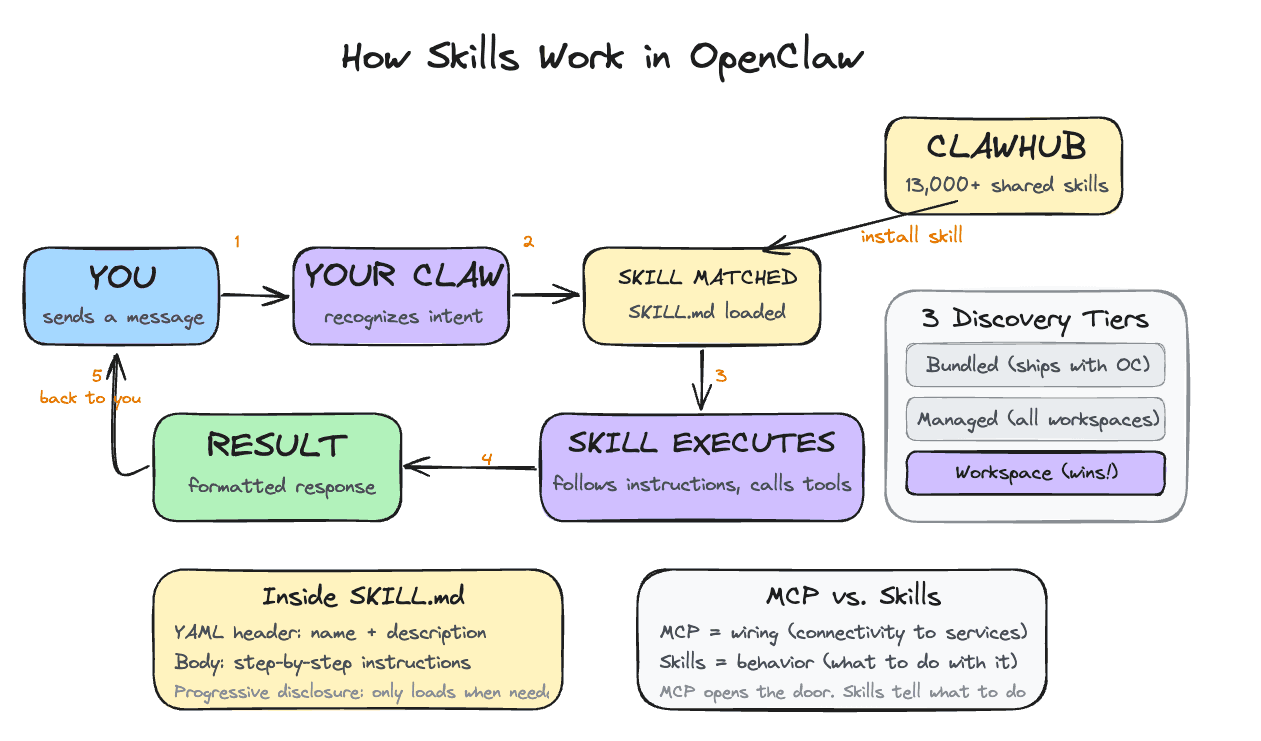
OpenClaw discovers skills from three locations, and when two skills share the same name, workspace wins.
Skill Discovery (workspace always wins)
Tier | Location | Scope |
|---|---|---|
Bundled | Ships with OpenClaw | Always available |
Managed |
| All workspaces |
Workspace |
| This agent only; takes precedence |
Bundled skills ship with OpenClaw and are always available without installation. These cover common integrations like web search, basic calendar read, and file access. They are a useful baseline that works out of the box.
Managed skills live in ~/.openclaw/skills/ and are installed via ClawHub. They are available across all your workspaces on the same machine. Good for general-purpose skills you want everywhere.
Workspace skills live inside your specific workspace at ~/.openclaw/workspace/skills/. Your workspace is the directory at ~/.openclaw/workspace/ that holds everything specific to your agent: the identity files from Day 2, the proactive step from Day 4, and now the skills directory. It's your agent's home.
In the Hostinger setup used in this course, you are not opening a shell and running these commands yourself. The paths and registry terms matter because they explain how OpenClaw works under the hood. Your Claw is the thing performing the inspection, install, and file-writing steps for you.
You can run multiple workspaces on the same OpenClaw installation, each one a separate agent with its own personality, rules, and skills. Workspace skills are scoped to this agent only, which makes them the right place for anything specific to your context: a skill that knows about your particular project structure, your internal tools, or your workflow.
When two skills share the same name, the workspace version takes precedence. This means you can modify how a bundled skill behaves by creating a workspace skill with the same name. It shadows the bundled version. The core installation stays untouched.
Inspecting Before Installing
Because anyone can publish a skill to ClawHub, malicious skills do show up. A coordinated attack campaign called ClawHavoc distributed skills under lookalike names (e.g., "gmail-reader" vs. "gmai1-reader"), close enough to legitimate ones that you could install one by accident. The techniques ranged from prompt injection in skill files to hidden scripts that steal credentials. The impact was real: users on always-on machines had API keys and tokens exfiltrated before they noticed anything was wrong.
One way to catch this, which works well in practice, is to run clawhub inspect <slug> before every install. This shows you the full SKILL.md without installing it. Read through it. If the instructions reference unknown endpoints, ask for data they should not need, or take actions outside the declared scope, skip it. This takes thirty seconds and catches a lot of issues, though it is not a complete guarantee. The clawvet tool (covered in Go Deeper) adds automated scanning on top of manual inspection.
Writing Your Own Skill
When to write one: When you catch yourself giving your Claw the same multi-step instruction for the third time. The first time, you're figuring out what you want. The second time, you're confirming the pattern. The third time, you're ready to write a skill.
How to think about it: Write the instructions the way you would explain the task to a capable person who has done it before in general, but has never done this specific version. What inputs do they need? What steps do they follow? What should they do if something goes wrong?
Here's a complete working skill that captures quick notes to your memory:
Example: quick-note/SKILL.md
---
name: quick-note
description: >
  Captures a quick note from messages starting with "note:".
  Classifies it, saves it to today's memory file, and tracks open loops
  when the note implies future action.

---

When the user sends a message starting with "note:", "remember:", or
"jot down:", extract the content after the trigger word.

1. Get today's date in YYYY-MM-DD format.
2. Open or create the file: memory/YYYY-MM-DD.md
3. Append the note with a timestamp:
   ## HH:MM
   [note content]
4. Confirm to the user: "Noted: [first 50 chars]..."

If the memory directory is missing, create it first.
The YAML header (the part between the --- markers) has a name and a description. The description is what the agent uses to decide when to invoke the skill. A vague description like "helps with tasks" triggers unpredictably, if at all. A specific description like "captures a quick note to today's memory file with a timestamp" triggers exactly when you want it.
The instruction body below the header is plain markdown. Write it the way you would explain the task to someone who needs to do it precisely: what inputs to expect, what to do with them, what output to produce, and what to do if something goes wrong. Plain English is all you need.
The quick-note skill above is a simple example, but the pattern scales. Skills for interacting with APIs, processing files, or running multi-step workflows follow the same structure: a clear description in the header and step-by-step instructions in the body.
One thing worth knowing: you rarely have to write skills entirely by hand. If you find yourself repeating a workflow, you can ask your Claw to draft the skill for you. Describe what you want ("every time I say 'standup', summarize my open tasks and send them to Telegram"), and your Claw generates the SKILL.md with the header, description, and step-by-step instructions. You review it, adjust anything that feels off, and save it to your workspace. Skills can also include shell scripts or other executable files alongside the markdown, so more complex workflows that need actual code are covered too.
Ready to Build?
You now understand what skills are, how they compare to MCP (wiring vs. behavior), why enterprises publish curated skills instead of exposing raw APIs, what a workspace is, how the three tiers of discovery work, why inspecting before installing matters, and how to write a custom skill or have your Claw draft one for you. The build walks you through what skills are already available, installs one from ClawHub, and helps you write your first custom skill.
Today you do the skill flow in stages. First you inspect a public skill. Then you install it. Then you create one small skill of your own.
ClawHub is OpenClaw's public skill registry. Think of it as the directory where people publish reusable skills so other OpenClaw users can inspect them, install them, and build on them. In this course, you do not interact with ClawHub directly through a shell. You ask your Claw to inspect or install a skill, and it handles the registry steps for you.
The operational steps are split between this file and a few small instruction files. This file is for you. The instruction files are for your Claw.
What You Need Before Starting
Day 1 complete: OpenClaw installed and secured
Day 2 complete: identity files created and loading correctly
Day 3 complete: Telegram connected and working
Day 4 complete: a proactive workflow already exists
Access to your Claw through the web chat
Telegram on your phone
How To Run Day 5
Work through the files in this order:
inspect
document-summaryin chat
This order gives you the full picture: how to inspect a public skill, how to install one safely, and how to teach your Claw one behavior of your own.
Step 1: Inspect a ClawHub Skill
Copy and paste the following message into the web chat:
Inspect
document-summaryfrom ClawHub, explain in plain English what it does, what kinds of requests should trigger it, whether it needs any credentials or extra binaries, and anything that looks risky or out of scope. Do not install anything yet.
Today's ClawHub skill example is document-summary. It is a good Day 5 starting point because it adds a reusable workflow without asking you to set up another account, secret, or API key first.
Step 2: Install document-summary
After you are happy with the inspection, copy and paste this into the web chat:
Read
https://raw.githubusercontent.com/aishwaryanr/awesome-generative-ai-guide/main/free_courses/openclaw_mastery_for_everyone/days/day-05-give-it-skills/claw-instructions-install-document-summary.mdand follow every step. Installdocument-summaryinto this workspace, tell me how to trigger it, and stop when you're done.
claw-instructions-install-document-summary.md tells the Claw to:
install
document-summaryinto this workspace after confirmationverify where it landed and whether it is ready
tell you the exact request patterns to use from Telegram or web chat
tell you to type
/newin OpenClaw before trying to use the new skill
This is the first half of Day 5. You borrow one good workflow instead of rebuilding it from scratch.
If you want a visual check, open Skills in OpenClaw. Installed workspace skills show up there once they have been added:
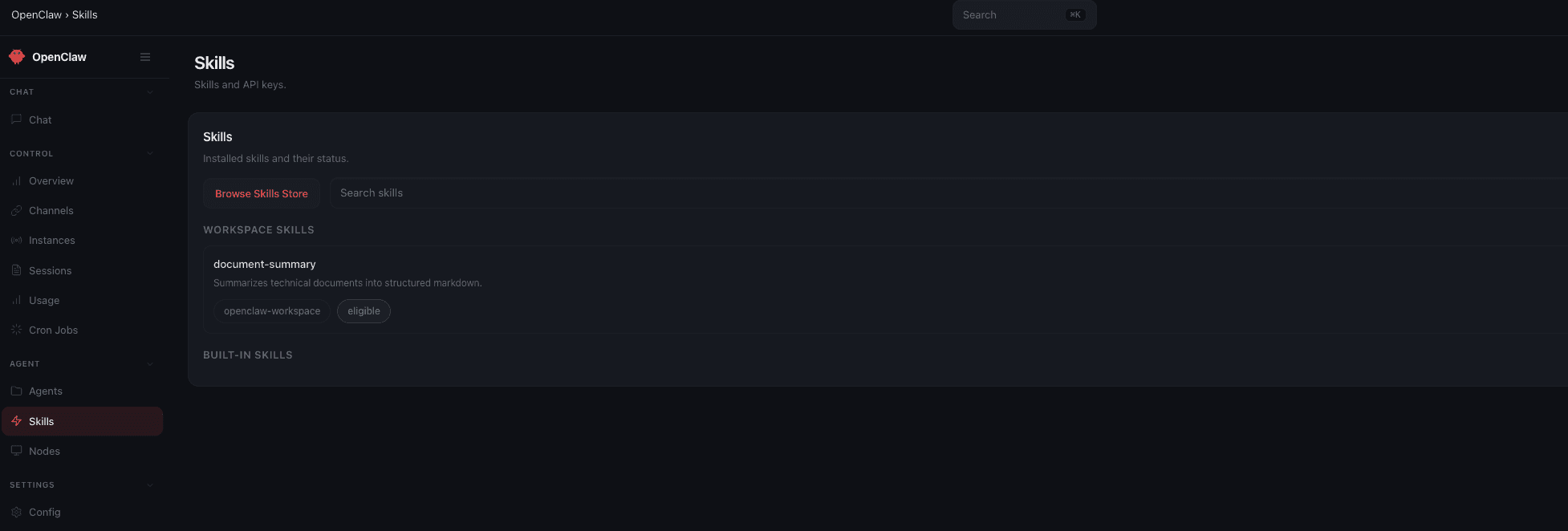
After this step, type /new in OpenClaw to start a fresh session before you continue.
Step 3: Create quick-note
After document-summary is installed, copy and paste this into the web chat:
Read
https://raw.githubusercontent.com/aishwaryanr/awesome-generative-ai-guide/main/free_courses/openclaw_mastery_for_everyone/days/day-05-give-it-skills/claw-instructions-create-quick-note-skill.mdand follow every step. Createquick-notein this workspace, tell me how to trigger it, and stop when you're done.
claw-instructions-create-quick-note-skill.md tells the Claw to create one small custom skill that:
triggers on
note:classifies the note before saving it
stores a clean timestamped entry in
memory/YYYY-MM-DD.mdadds an open-loop item when the note implies future action
replies with a short confirmation
This is the second half of Day 5. You teach your Claw one behavior that is specific to how you work.
After this step, type /new in OpenClaw to start a fresh session before you continue.
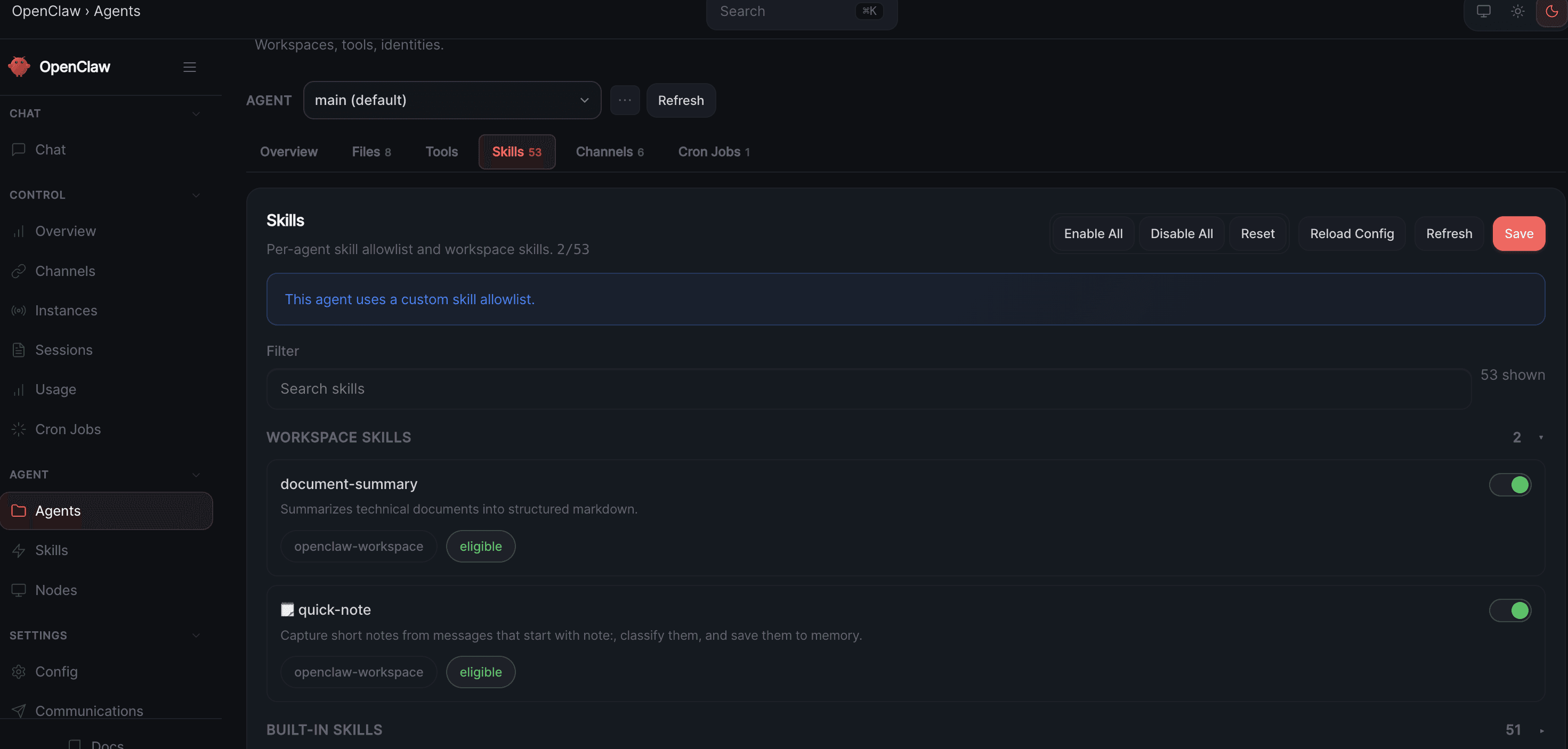
!!! Warning !!!!
Do an additional check on the OpenClaw Web interface, go to
Agents --> Skillsand make sure that the skills are enabled.
Step 4: Finalize and Verify
After quick-note is created, copy and paste this into the web chat:
Read
https://raw.githubusercontent.com/aishwaryanr/awesome-generative-ai-guide/main/free_courses/openclaw_mastery_for_everyone/days/day-05-give-it-skills/claw-instructions-finalize-skills.mdand follow every step. Verify both skills, tell me the exact test message for each one, and report PASS or FAIL.
That instruction file tells it to:
confirm both skills are present
remind you that Day 5 skills are used from a fresh session after
/newgive you the exact message to test each skill
report PASS or FAIL for the Day 5 setup
At that point, your Claw has one reusable workflow from the community and one you created together.
Validate It
Ask your Claw in the web chat:
Tell me the two skills we set up today, where each one lives, the exact message I should send to test each one, and whether I need a fresh session before they are active.The answer should clearly name document-summary, quick-note, their locations, the trigger phrases, and remind you to use /new before testing newly added skills.
Quick Win
From Telegram, send one real note: message that implies future action. Then paste a link or a short block of text and ask for a summary. This is the Day 5 shift: your Claw now carries one reusable workflow from the community and one you taught it yourself, and your custom skill is doing more than dumping raw text into a file.
What Should Be True After Day 5
document-summarywas inspected before installdocument-summarywas installed for this workspacequick-noteexists as a custom workspace skill with its ownSKILL.mdquick-notecan classify notes and track open loops when neededYou know the exact trigger or request to use for both skills
You started a fresh OpenClaw session with
/newbefore testing the new skillsBoth skills are scoped to this agent unless you chose otherwise
Troubleshooting
The Claw starts doing everything in one shot Tell it to stop and stay inside the current Day 5 step. The point is to inspect, install, create, and verify in sequence.
The inspection feels vague Ask it to explain document-summary in plain English: what it does, what should trigger it, and what it depends on.
The custom skill description feels fuzzy Ask the Claw to rewrite it around the exact note: trigger you plan to send from Telegram.
The skill does not seem available yet Type /new in OpenClaw to start a fresh session, then test again.
Tomorrow is the first real integration: email. The skills you've added today will start becoming useful as your Claw gains access to more of your world.
Go Deeper
The SKILL.md format supports metadata gates: you can require specific CLI tools to be installed, environment variables to be set, or restrict a skill to specific operating systems. The SKILL.md specification covers the full list of supported gates.
The
clawvettool automates security scanning for skills. Runclawvet scan <skill-dir>on any skill directory to check for known malicious patterns, suspicious outbound calls, and scope violations before you install.If you've built an MCP server, you're 90% of the way to building an OpenClaw skill. The MCP server handles the connectivity; wrapping it in a SKILL.md with workflow instructions turns it into a full skill. The ClawHub documentation on MCP conversion covers the pattern.