
Prefer video? Watch this chapter on YouTube
Includes 3 bonus chapters on building evals with Arize AI
 Watch on YouTube
Chapter 08
The Complete Evaluation Process
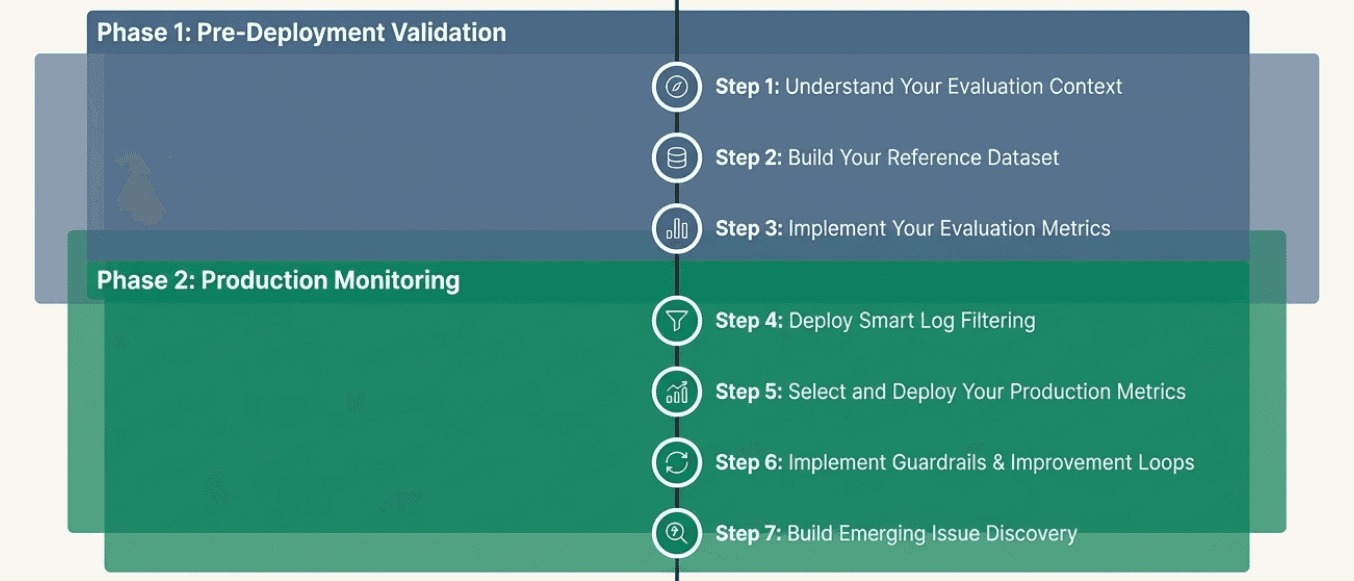
From Concept to Production: Your Step-by-Step Guide
In the previous seven chapters, we've covered the complete landscape of AI evaluation - from understanding why it matters to deploying production monitoring systems. Now let's consolidate everything into a clear, step-by-step process you can follow to build robust evaluation for your AI system.
This chapter serves as your practical roadmap, connecting all the concepts we've discussed into actionable steps you can implement.
The Two-Phase Approach
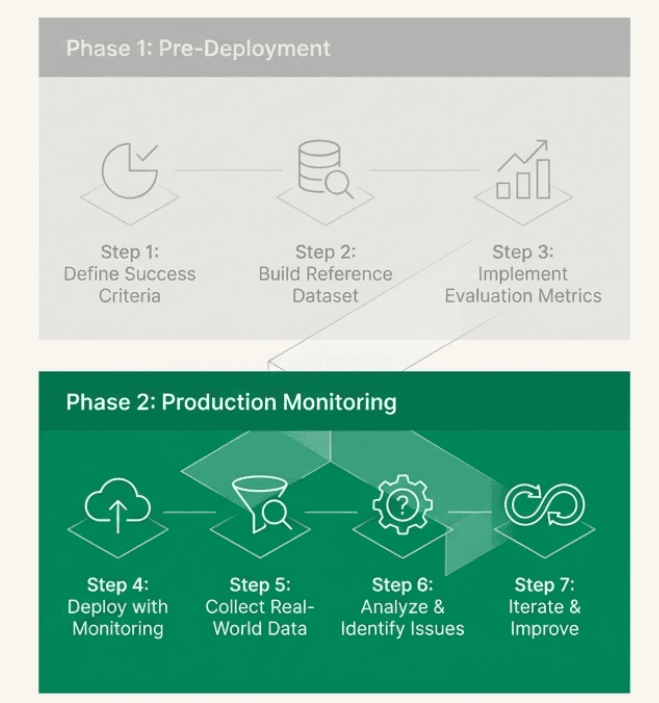
AI evaluation follows two distinct phases:
Phase 1: Pre-Deployment Validation (Chapters 1-5)
Build confidence that your system works as intended before users interact with it
Create systematic evaluation frameworks and metrics
Test thoroughly in controlled conditions
Phase 2: Production Monitoring (Chapters 6-7)
Monitor system performance with real users at scale
Discover new issues and evolving user behaviors
Continuously improve your system and evaluation approach
Here's how to work through each phase.
Phase 1: Pre-Deployment Validation
Step 1: Understand Your Evaluation Context
Based on Chapters 1-3
What you're doing: Establish the foundation for your evaluation approach by understanding what makes AI evaluation unique and what you need to measure.
Key decisions: Recognize that your AI system is non-deterministic, focus on product evaluation (how your system behaves in your specific use case) rather than model evaluation, and identify the three components you're evaluating - Input, Expected, and Actual.
What to do: Start by mapping out your specific use case and domain requirements. Identify stakeholders who need to be involved - domain experts, product teams, and engineers. Remember that generic metrics like "helpfulness" mean different things in different contexts, so prepare for collaborative evaluation design across different team perspectives.
Output: Clear understanding that you're building evaluation for your specific context, not just testing general AI capabilities.
Step 2: Build Your Reference Dataset
Based on Chapter 4
What you're doing: Create a systematic collection of examples that represent the scenarios you care about most, with clear expectations for how your system should behave.
Key decisions:
Start small and specific (10-20 high-quality examples) rather than trying to be comprehensive
Focus on scenarios you absolutely cannot get wrong
Include realistic inputs that represent actual user behavior
Action items:
Generate initial examples: Work with domain experts to create realistic scenarios based on historical data or domain knowledge
Run your system: Test your AI system on these examples and document both outputs and any intermediate steps
Evaluate with experts: Have domain experts review each example and answer "Was this response satisfactory? If not, why not?"
Identify error patterns: Analyze failures to cluster them into underlying problems you can actually fix
Decide on ongoing metrics: Determine which behaviors need continuous monitoring (recurring risks) versus one-time fixes
Output: A reference dataset with examples, system outputs, expert evaluations, and identified metrics for ongoing measurement.
Step 3: Implement Your Evaluation Metrics
Based on Chapter 5
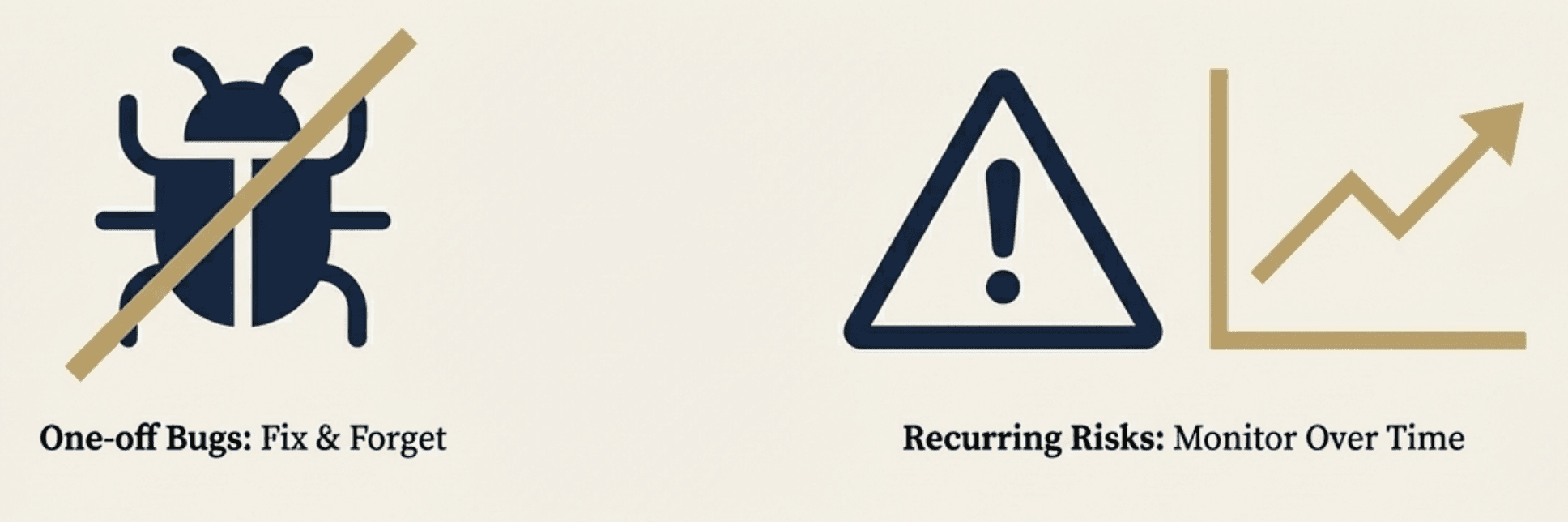
What you're doing: Build the actual measurement systems that can assess your identified metrics using three possible approaches.
Key decisions:
Choose the right mix of human evaluation, code-based metrics, and LLM judges
Start simple and add complexity only when needed
Remember that LLM judges require careful calibration against human judgment
Action items:
For objective, measurable properties: Implement code-based metrics (structure validation, performance checks, required content)
For subjective qualities: Consider LLM judges with detailed rubrics and examples
For critical quality assessment: Plan for human evaluation, at least for calibration and spot-checking
Build rubrics: Create clear criteria defining acceptable vs. not acceptable performance with specific examples
Test your metrics: Validate that your evaluation approaches actually catch the issues you care about
Calibrate LLM judges: If using them, extensively test against human judgment and iteratively refine
Output: Implemented evaluation metrics that can reliably assess the behaviors you identified in Step 2.
Phase 2: Production Monitoring
Step 4: Deploy Smart Log Filtering
Based on Chapter 7 - Log Filtering
What you're doing: Create systematic approaches to identify which production data deserves attention, since you can't manually review everything at scale.
Key decisions:
Define what matters most for your business context (high/medium/low priority events)
Choose which implicit and explicit user signals to monitor
Set up dynamic filtering that adapts to production changes
Action items:
Establish priority categories: Define which events always need attention vs. which can be sampled
Identify user signals: Look for patterns like unusual conversation length, retry behavior, editing patterns, frustration indicators
Set up signal-based sampling: Sample more heavily from interactions showing concerning signals
Monitor production changes: Increase sampling during new product launches, error rate spikes, or business requirement changes
Adapt over time: Adjust your filtering strategy based on what you learn
Output: A filtering system that efficiently identifies the most important production data to examine.
Step 5: Select and Deploy Your Production Metrics
Based on Chapter 7 - Metric Selection
What you're doing: Choose which evaluation metrics to run in production based on their impact, reliability, and cost.
Key decisions:
Prioritize high-impact metrics that drive actionable improvements
Balance metric value against computational and financial costs
Focus resources on metrics that actually help you make better decisions
Action items:
Evaluate each metric: Assess impact (how much it helps improve your system), reliability (how consistent it is), and cost (computational/financial expense)
Prioritize systematically: Focus on high-impact, low-cost metrics first; carefully consider high-impact, high-cost metrics; avoid low-impact approaches regardless of cost
Start essential: Implement must-have metrics that provide basic system health and safety monitoring
Add strategically: Gradually incorporate more sophisticated metrics based on demonstrated value
Output: A cost-effective mix of evaluation metrics running in production.
Step 6: Implement Guardrails and Improvement Loops
Based on Chapter 7 - Online vs Offline Evaluation
What you're doing: Distinguish between metrics that need immediate intervention (guardrails) versus those that guide longer-term improvement.
Key decisions:
Identify which behaviors, if they go wrong, would be huge for your business (guardrails)
Design offline evaluation for trend analysis and system improvement
Balance real-time intervention needs with batch analysis efficiency
Action items:
Design guardrails: Implement fast, reliable online metrics for business-critical behaviors that trigger immediate actions (handoffs, escalations, blocks)
Set up improvement loops: Create offline evaluation processes that analyze trends, assess quality over time, and guide system improvements
Define trigger actions: Establish clear procedures for what happens when guardrails activate
Plan feedback cycles: Ensure offline analysis insights feed back into system improvements and evaluation refinements
Output: A two-tier system with real-time guardrails for critical issues and batch analysis for continuous improvement.
Step 7: Build Emerging Issue Discovery
Based on Chapter 7 - Emerging Issue Discovery
What you're doing: Create processes to discover problems your existing evaluation framework doesn't capture, using the same manual investigation techniques from reference dataset building.
Key decisions:
Recognize that user signals often reveal problems before metrics do
Plan for manual investigation when signals and metrics diverge
Build systematic processes to evolve your evaluation framework over time
Action items:
Monitor signal-metric divergence: Watch for cases where user behavior signals flag issues but your metrics show no problems
Conduct manual investigation: When divergence occurs, manually review the flagged interactions just like you did when building reference datasets
Identify hidden issues: Look for quality dimensions or failure modes your current metrics don't capture
Develop new metrics: Create evaluation approaches for newly discovered issues
Update your framework: Add new metrics to your evaluation system and refine your filtering approach
Close the discovery loop: Ensure insights from investigation feed back into better evaluation and system improvements
Output: A continuously evolving evaluation framework that adapts as you discover new issues and user behaviors.
The Complete Process Flow
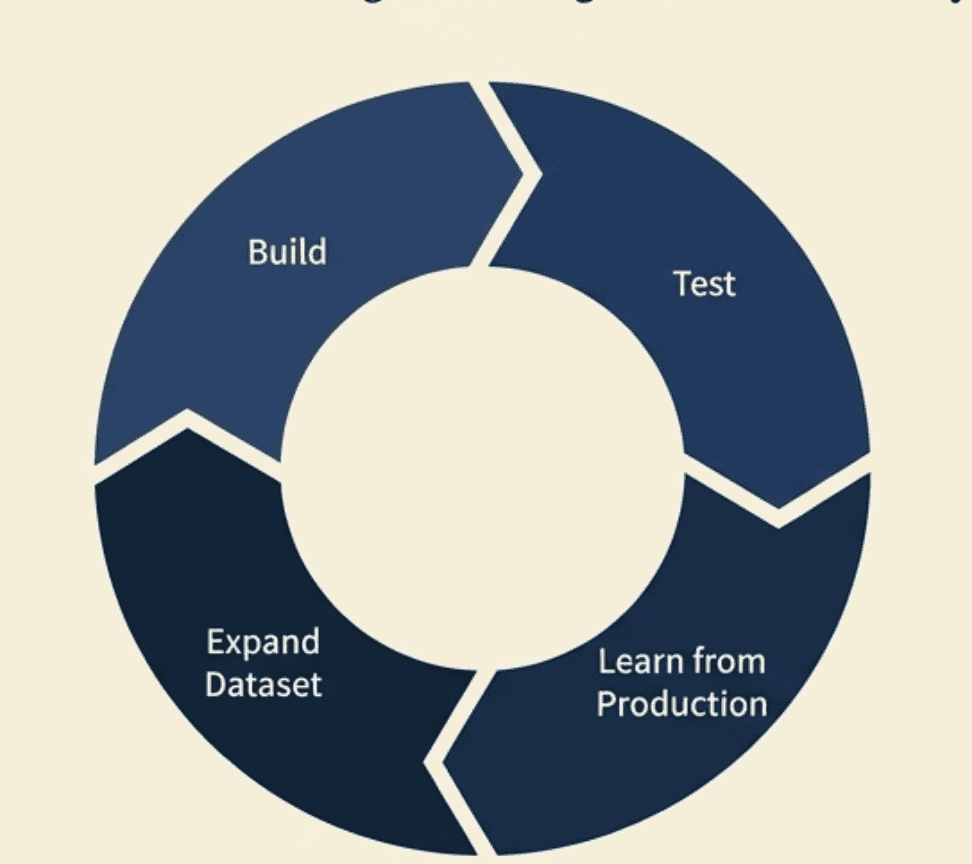
Here's how all these steps connect:
Foundation → Understand your specific evaluation needs and context
Reference Dataset → Build systematic examples with clear quality expectations
Metrics Implementation → Create reliable measurement systems for your quality criteria
Production Filtering → Efficiently identify important production data to examine
Metric Deployment → Run cost-effective evaluation at scale
Guardrails + Improvement → Handle critical issues immediately while building long-term improvement
Discovery Loop → Continuously evolve your evaluation as you learn new failure modes
Key Principles Throughout
Start Simple: Begin with basic approaches and add complexity only when justified by clear value.
Focus on Context: Generic evaluation approaches don't work - everything must be tailored to your specific use case, users, and business requirements.
Collaborate Across Teams: Effective evaluation requires input from domain experts, product teams, and engineers working together.
Embrace Evolution: Your evaluation framework should continuously improve as you discover new ways your system can fail or as user expectations change.
Connect Evaluation to Improvement: The goal is better AI systems, not perfect measurement. Focus on evaluation that drives actionable improvements.
What You End Up With
Following this complete process gives you:
Confidence before deployment: Systematic validation that your system works as intended
Effective production monitoring: Smart filtering and evaluation that scales with your system
Proactive issue detection: Early warning systems that catch problems before they become major issues
Continuous improvement: Feedback loops that help your system get better over time
Sustainable evaluation: Cost-effective approaches that provide value without overwhelming your team
The Ongoing Journey
Remember that evaluation is never complete. You start by building evaluation for patterns you can anticipate, then use production monitoring to discover and evaluate patterns you couldn't predict. User behavior evolves, business requirements change, and new failure modes emerge.
The framework we've built gives you the tools to adapt your evaluation approach as your understanding deepens and your system grows. The key is maintaining the discipline of systematic evaluation while staying flexible enough to learn and evolve.
This complete process transforms evaluation from an afterthought into a core capability that helps you build more reliable, useful, and trustworthy AI systems.